

The MBS Highway National Housing Index jumped in February 2026, rising 9 points from January to 43. A year ago, the index stood at 41. Lower mortgage rates and improved affordability are boosting the normal seasonal upswing.
National Data
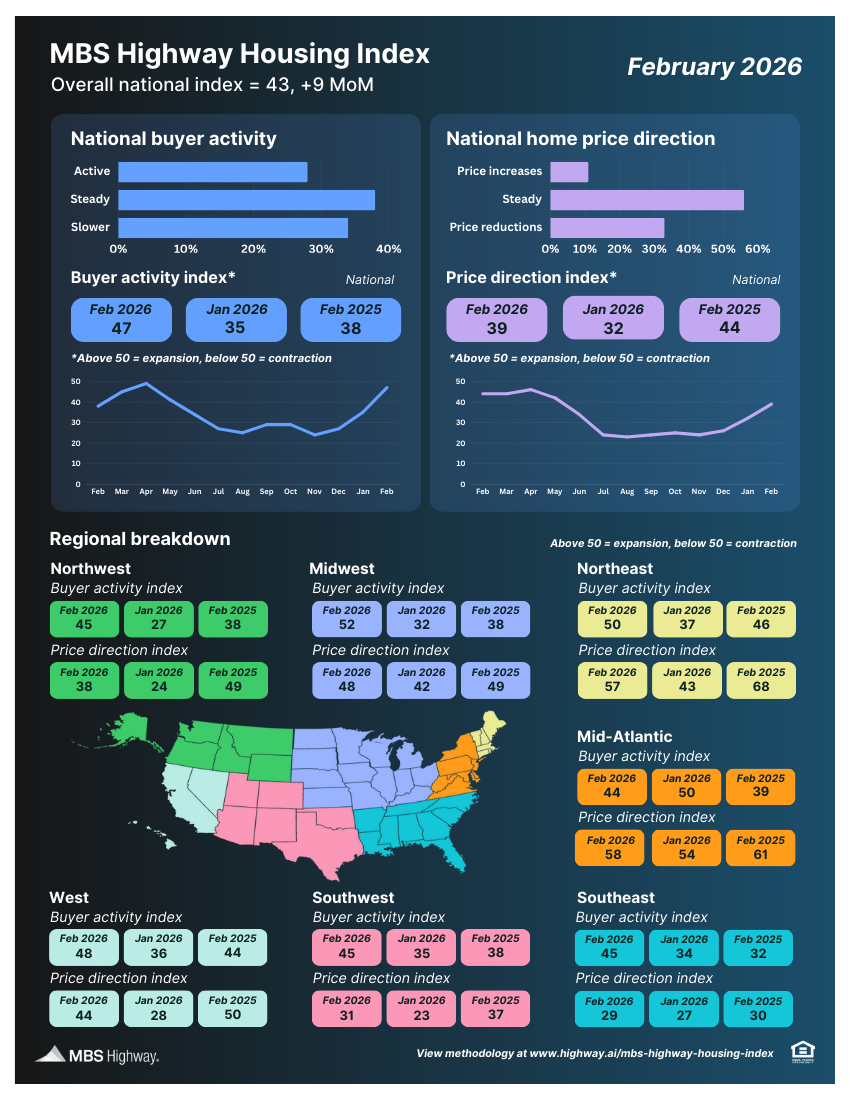
In February, the MBS Highway National Housing Index jumped 9 points to 43, 2 points above its level a year earlier. The typical seasonal upswing is clearly getting an extra boost from lower rates and improved affordability. An index reading of 50 separates contraction (below 50) from expansion (above 50).
Buyer activity leapt 12 points MoM to 47, well above its year-ago level of 38. Nationwide, 28% of respondents described current buyer activity as active. That figure was 22% a year ago. Price direction rose a less dramatic 7 points MoM to 39, which remains below its February 2025 level of 44.
Overall, the February survey results are consistent with an environment of rising demand with modest nationwide price growth. Should mortgage rates remain in the low 6% range (or move even lower into the high 5% range), we should see the overall index move into expansion territory (>50) for the first time in 20 months.
Regional Data
Buyer activity increased in six of seven regions, led by the Midwest (+20 to 52) and Northwest (+18 to 45). Two regions (Northeast and Midwest) now have buyer activity levels at or above the 50 mark signaling expansion territory.
Price direction improved in all seven regions, though the increases were generally less pronounced. The West (+16 to 44), Northeast (+14 to 57) and Northwest (+14 to 38) saw the largest gains. The Northeast joined the Mid-Atlantic with their price direction sub-indexes now at expansionary levels.
Question of the Month
With President Trump’s recent Executive Order to ‘ban’ large investors from buying single-family homes, we asked our customers: How much of an impact have large, institutional investors like Blackstone or Invitation Homes had on your market?
- Small (hardly any activity or impact)
- Medium (most/growing share of transactions, some price impact, some anti-investor reaction)
- Large (large share of transactions, significant price impact, strong anti-investor reaction)
Overall, 62% of respondents said that large institutional investors were having a small impact on their market. 32% said medium, and only 6% said large. This is roughly consistent with large institutional investors owning something like 1–3% of single-family homes nationwide.
Where were large investors having the biggest market impact? In the Southwest (Texas, Arizona, etc.) where 10% of respondents said investors were having a large impact, and in the Southeast (Florida, Georgia, etc.) where 9% saw significant impact.
Related posts

FAQ: Can I negotiate more than just the price of a home?

.png)
Softer Inflation, Weak Hiring, and Resilient Home Prices

FAQ: What is a mortgage rate buydown?
Ready to close more deals?
ListReports automatically delivers personalized marketing collateral to your inbox helping you engage with your customers and prospects.