

.jpg)
At its December 10 meeting, the Federal Reserve cut its benchmark Fed Funds Rate by 25 basis points, lowering the target range to 3.50%-3.75%. This marked the Fed’s third rate cut of the year, following similar moves in September and October. While this rate doesn’t directly determine mortgage rates, it plays a major role in influencing borrowing costs across the economy.
The decision, however, wasn’t unanimous. Governor Stephen Miran supported a larger 50-basis-point cut, while Kansas City Fed President Jeffrey Schmid and Chicago Fed President Austan Goolsbee preferred to keep rates unchanged. The split highlights the Fed’s challenge: inflation remains above the Fed’s 2% target, while the job market is softening.
These competing pressures can pull policy in opposite directions, with inflation delaying rate cuts and economic slowing prompting them.
Fed Chair Jerome Powell has emphasized that there is “no risk-free path” forward, and updated projections show just how divided policymakers are. Six of the nineteen Fed officials favored holding rates steady at this meeting, reflecting hesitation among both voting and nonvoting members.
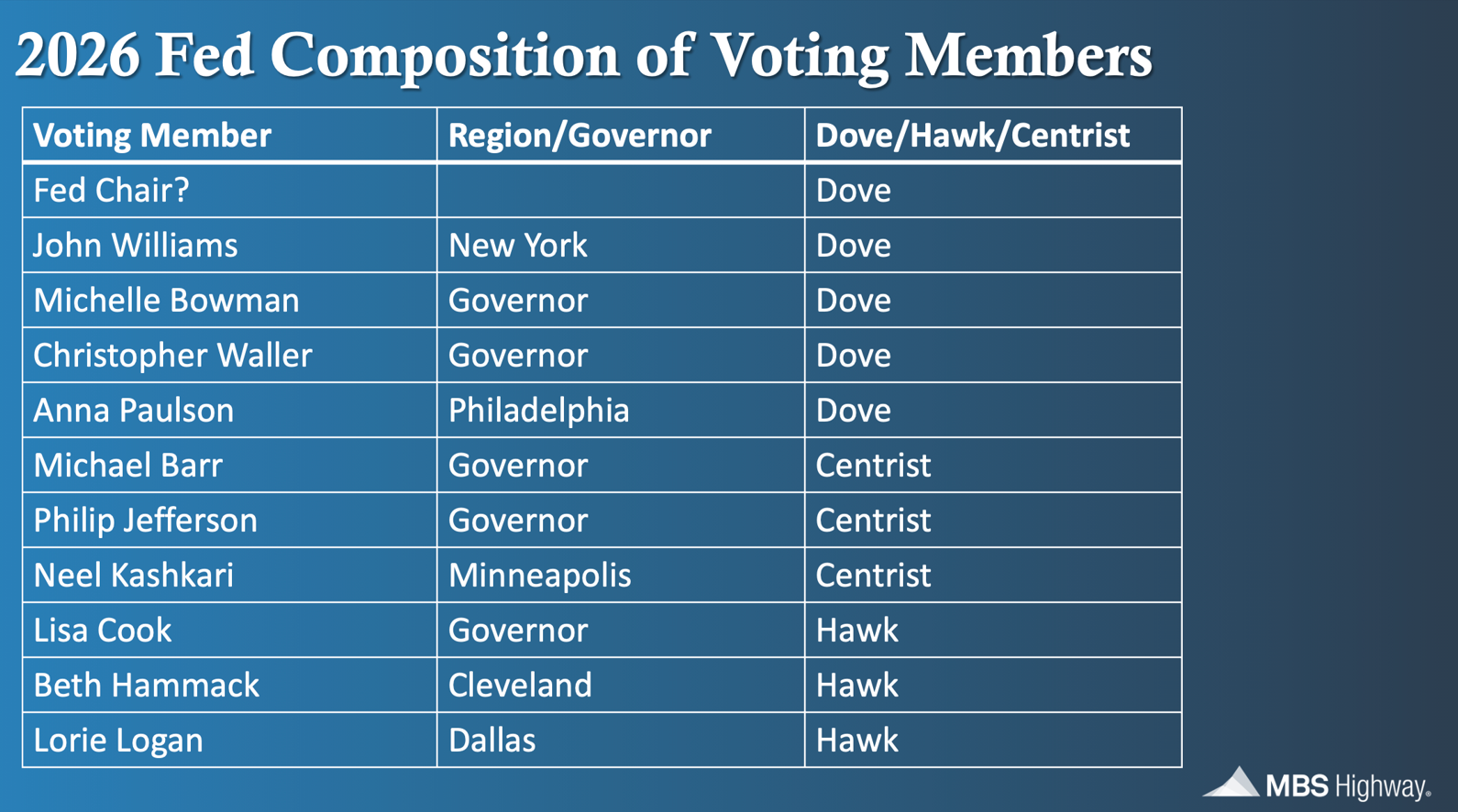
Looking ahead to 2026, the median forecast points to at least one additional 25-basis-point cut. But that outlook could change as new voting members rotate in, which highlights how important the Fed’s voting committee composition will be.
The seven Fed Governors, including the Chair, always have a vote, and the New York Fed President is a permanent voting member. The remaining voting seats rotate among the regional Fed Presidents each year, which can shift the balance between officials who prioritize fighting inflation (hawks) and those more focused on supporting employment (doves).
In 2026, the voting committee is expected to become more dovish. Chair Jerome Powell’s term expires in May, and while President Trump has not yet announced his replacement, the next Fed Chair is widely expected to favor lower interest rates, aligning with the administration’s preference for easier monetary policy.
Powell has not indicated whether he will remain at the Fed as a Governor after his term as Chair expires. If he does not, any new Governor appointed by President Trump would likely be dovish.
In addition, several vocal inflation hawks – including December’s dissenters Goolsbee and Schmid – will rotate off the voting committee. Taken together, these changes suggest the Federal Reserve may become more open to cutting rates in 2026 if downside risks to the labor market persist.
Want insights like this every day?
An MBS Highway membership gives you access to expert insights and powerful tools built to help you stand out in a competitive market.
From our Bid Over Asking Price calculator and Buy vs. Rent Comparison to the Loan Comparison tool, daily coaching videos, and real-time lock alerts, you’ll have everything you need to advise clients with confidence and win more business.
Establish yourself as the trusted expert homebuyers turn to as the market continues to evolve.
Start your free 14-day trial of MBS Highway and discover how we help you grow your business and stay one step ahead.
By Shelly Williams
Related posts

FAQ: Can I negotiate more than just the price of a home?

.png)
Softer Inflation, Weak Hiring, and Resilient Home Prices
FAQ: What is a mortgage rate buydown?
Ready to close more deals?
ListReports automatically delivers personalized marketing collateral to your inbox helping you engage with your customers and prospects.